 WTPAW
WTPAW
Turning Waste
Into Power
& Water
The American Southwest is facing converging crises — water scarcity, landfill overflow, and energy vulnerability. WTPAW engineers integrated infrastructure that solves all three simultaneously.
Southwest US
CA · NV · AZ · UT · CO · NM · WY
US & Mexico
Networked Model
Development at Scale
Waste to Power and Water LLC (WTPAW) is a strategic energy and water infrastructure developer. We design, develop, and deploy integrated systems that convert municipal solid waste into mechanical power, clean water, green hydrogen, and chemical feedstocks — simultaneously addressing the world's most critical resource challenges.
Our core innovation is direct mechanical power drive — turbine shafts coupled directly to high-pressure SWRO pumps, eliminating electrical conversion entirely. Combined with advanced gasification and syngas conversion, this creates a unified industrial ecosystem unlike anything else in the world.
WTPAW operates at the intersection of energy security, water supply, and environmental remediation — serving regional governments, federal agencies, and communities across the American Southwest and beyond.
Energy Development
Direct mechanical power drive — turbine shafts coupled straight to SWRO pumps. No generators. No electrical losses. Pure mechanical force driving desalination.
Water Supply
Large-scale seawater desalination powered by waste-derived energy — delivering new water supply independent of existing freshwater sources.
Strategic Development
End-to-end project development from concept through construction, operations, and regional partnership.
Water Scarcity
Decades of drought, over-allocation, and population growth have pushed the Colorado River Basin to crisis. Communities across the Southwest are running out of reliable freshwater supply.
Waste Overflow
American landfills accept over 140 million tons of municipal solid waste every year. Most of it buries recoverable energy, pollutes groundwater, and costs communities billions in tipping fees.
Energy Dependency
Water infrastructure is one of the most energy-intensive systems in existence. Pumping and treating water at scale demands reliable, affordable power — the kind that carbon-heavy grids struggle to deliver.
"What if the city's greatest liability — its waste — became the engine that powers its most essential resource: water?"
Multi-Output Ecosystem
The S2F system is not a single machine — it is a multi-output industrial ecosystem where one waste input stream is intelligently split across three distinct gasification pathways, each optimized to produce a different critical output.
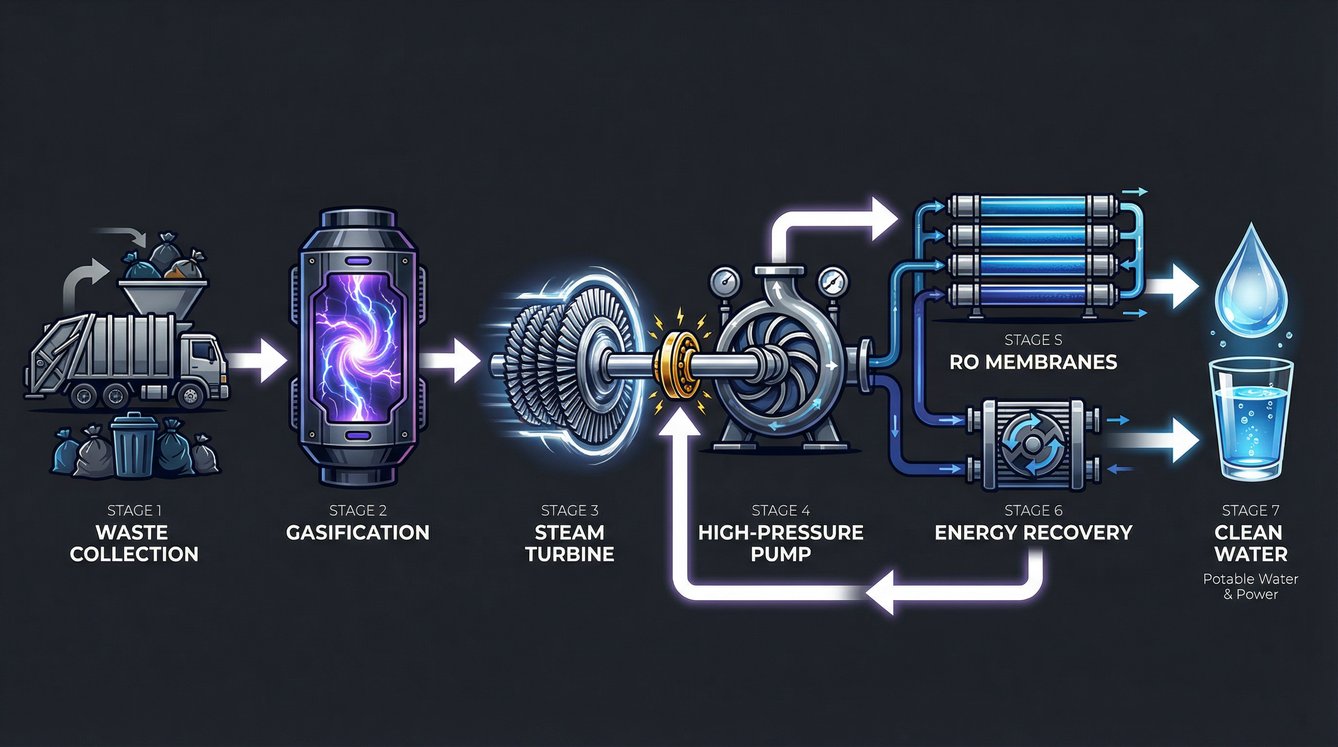
The S2F System — 7-Stage Process: Waste Collection → Gasification → Steam Turbine → Direct-Drive High-Pressure Pump → RO Membranes → Energy Recovery → Clean Water & Power
Fluidized Bed Gasification
The workhorse of the system. Syngas combustion drives high-pressure steam turbines whose shafts are mechanically coupled directly to SWRO pumps — no generators, no electrical conversion, no losses.
Plasma Gasification
Ultra-high temperature plasma arcs — hotter than the surface of the sun — completely destroy complex and hazardous waste fractions. Ultra-clean syngas produces 99.99% pure green hydrogen.
Microwave Gasification
Precision electromagnetic energy breaks down specific waste fractions — particularly plastics — to produce targeted high-value chemical feedstocks for the industrial supply chain.
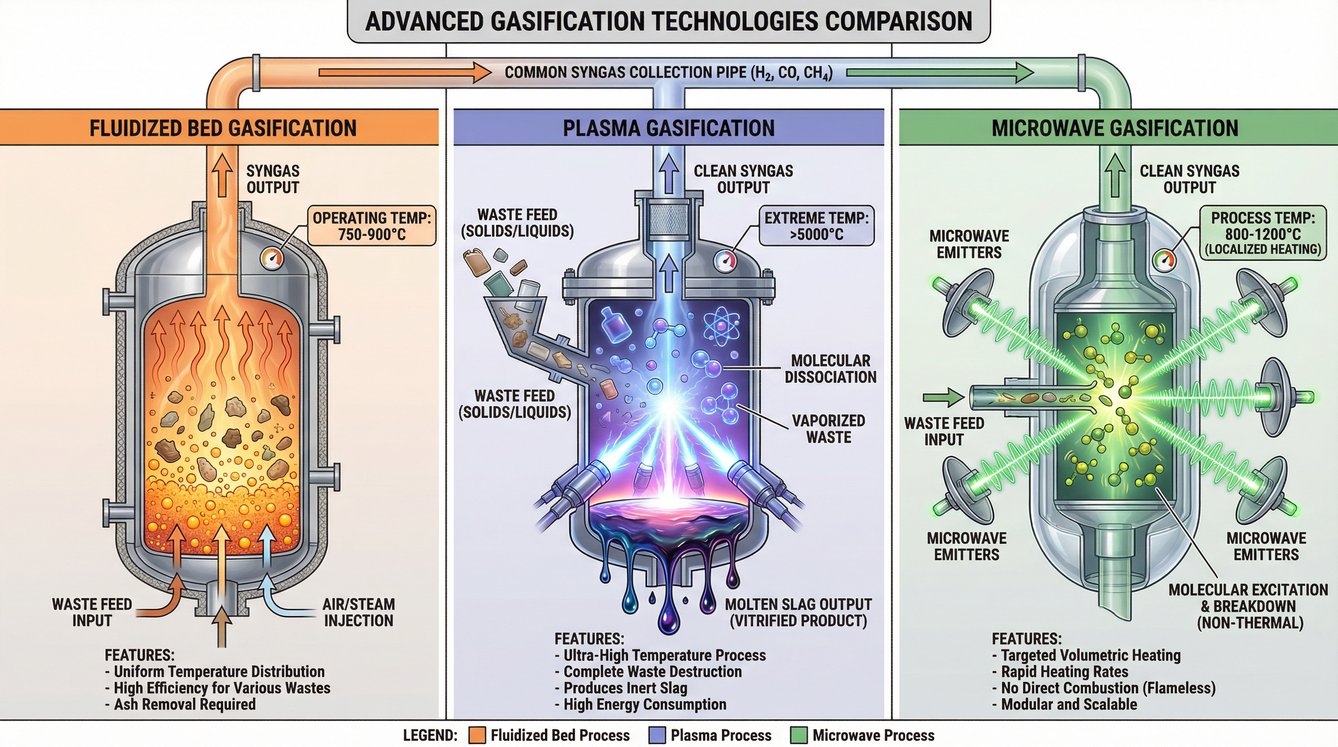
Advanced Gasification Technologies Comparison — Three pathways, one common syngas collection pipe (H₂, CO, CH₄)
The Production Chain
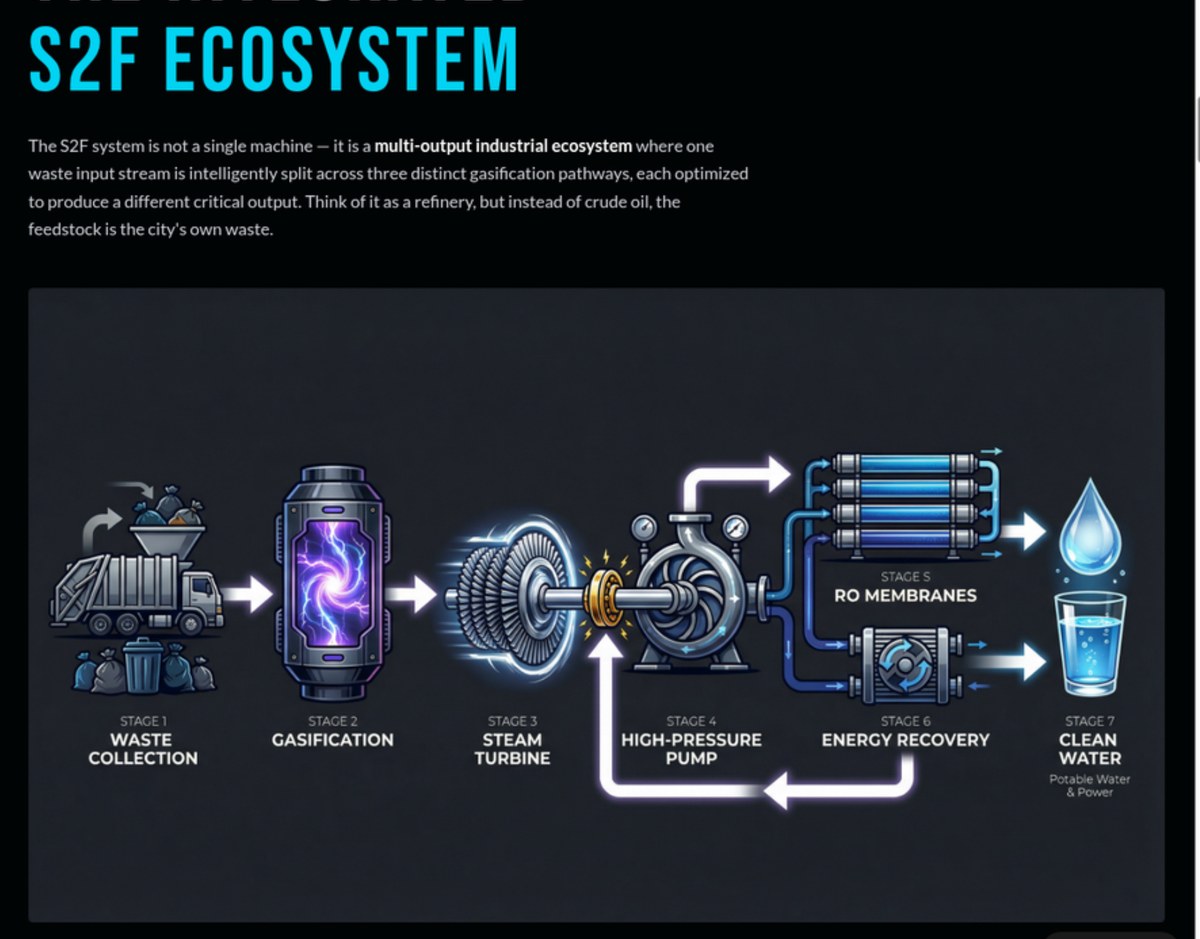
The S2F Ecosystem — multi-output industrial system where waste becomes water, power, hydrogen, and chemicals
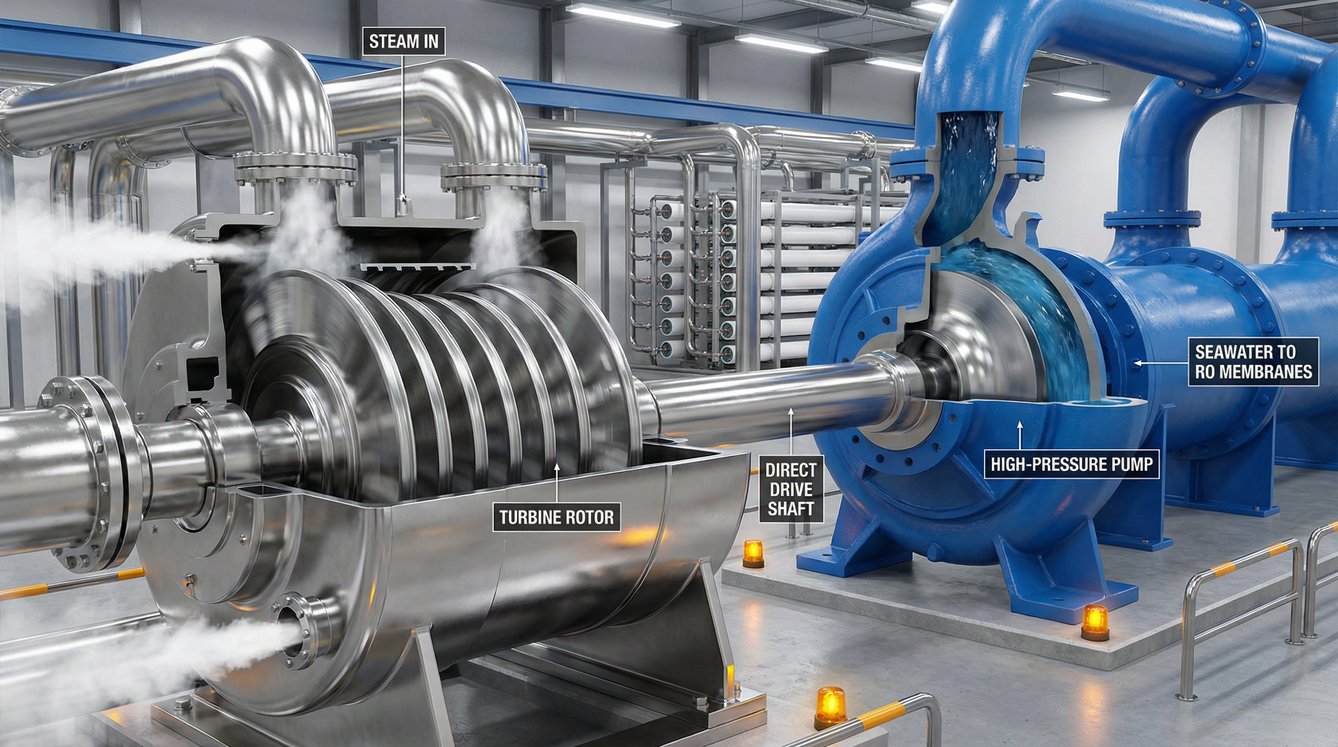
Direct Mechanical Power Drive — Turbine shaft coupled directly to the SWRO high-pressure feed pump. No generator. No motor. No electrical conversion. The shaft IS the pump driver.
On-Site MSW Processing at the Landfill
Raw municipal solid waste is processed at the source landfill — sorted, shredded, and converted into RDF (Refuse Derived Fuel) pellets on-site. This eliminates the cost and risk of hauling raw, unprocessed waste. Compact, pre-processed RDF pellets are then loaded directly onto the locomotive fleet for transport to the facility.
Syngas Generation
Waste is converted to synthesis gas (H₂ + CO) through fluidized bed, plasma, or microwave gasification — each operating at different temperatures and producing different syngas profiles optimized for downstream use.
Direct Mechanical Power Drive
The core innovation: syngas combustion generates high-pressure steam driving turbines whose shafts are mechanically coupled directly to SWRO high-pressure pumps. No generator. No motor. No electrical conversion losses. The turbine shaft IS the pump driver — raw mechanical force turning waste into water.
Emissions Control
All syngas passes through a multi-stage cleaning train: cyclone separator → fabric bag filter → wet scrubber tower → selective catalytic reduction (SCR). The only emissions are clean steam and purified products.
Water Post-Treatment & Distribution
RO permeate is remineralized to WHO drinking water standards — calcium, magnesium, and bicarbonate added for health and infrastructure compatibility. UV disinfection and chlorination provide final safety before delivery.
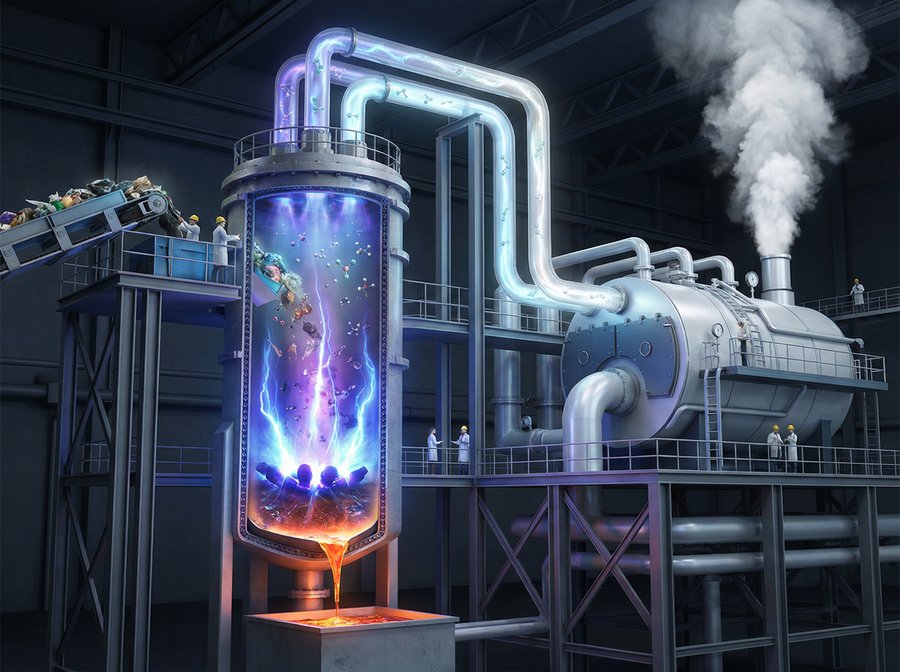
Fluidized Bed Reactor — 750–900°C continuous feed, high throughput syngas production
The Fluidized Bed Reactor
The Analogy: The Boiling Sandstorm
Imagine a pot of sand heated so intensely that the particles begin to float and behave like a liquid — a boiling, churning bed of superheated material. Waste fed into this environment is instantly surrounded by heat on all sides, breaking down uniformly without burning. This is the fluidized bed: not a fire, but a molecular storm.
Waste is fed into a reactor vessel where a bed of inert material is fluidized by upward-flowing steam or air at extreme temperature. The waste particles are suspended and uniformly heated in a low-oxygen environment, breaking chemical bonds to produce syngas (H₂ + CO) rather than combustion products.
Mechanical Power
- Direct shaft-to-pump mechanical drive
- Zero electrical conversion losses
- Baseload — 24/7, weather-independent
- Surplus power exported to regional grid
Potable Water
- SWRO desalinated seawater
- Meets WHO drinking water standards
- Remineralized and pH-balanced
- Independent of freshwater sources
Green Hydrogen
- 99.99% pure H₂ via PSA separation
- Fuel cell vehicle fuel
- Ammonia synthesis feedstock
- Long-duration energy storage
Chemical Products
- Methanol — liquid fuel & chemical base
- Ammonia — fertilizer & H₂ carrier
- Carbon black — rubber, batteries, ink
- Vitrified slag — construction aggregate
American Southwest
WTPAW's integrated system is designed to serve the most water-stressed region in the United States — delivering new water supply and energy infrastructure independent of existing freshwater systems.
WTPAW brings together decades of combined experience in integrated infrastructure development, strategic planning, advanced energy systems, and community engagement.
Eduardo Quezada
Lead Strategist
Infrastructure strategist with deep expertise in water security, public-private partnerships, and large-scale project development across the American Southwest.

Devin Cristal Q. Walton
Leading WTPAW's community engagement strategy, ensuring that development is aligned with the needs and priorities of the communities we serve — including underserved regions and cross-border stakeholders.
Join the Team
WTPAW is growing. We are seeking experienced professionals in water infrastructure, gasification engineering, and project finance to join our mission.
Ready to Build Something That Lasts?
For inquiries about our solutions, partnership opportunities, or to schedule a briefing, please reach out.